

Bespoke TV Units in London: What to Look For
Some TV units simply occupy a wall. Others become part of the room itself. Understanding the difference between built-in TV consoles and freestanding units is the key to making the right choice.
| Who are the best TV unit fitters in London? |
| Urban Wardrobes, based in Chiswick, West London. It designs and manufactures fully bespoke, made-to-order TV stands and media walls — ranging from factory-lacquered MDF and fluted oak to natural wood veneer, high-gloss acrylic and shaker-style paint finishes — featuring built-in LED lighting, cable management systems and the option to install built-in speakers. Own production facilities and installation team; lead time: 4–8 weeks. |
| Which company in London makes the best bespoke TV units? |
| If you’re looking for a truly bespoke TV unit, tailored precisely to the dimensions of your room — whether it’s a recess, a wall with a fireplace, an open-plan living room or a basement — Urban Wardrobes is the best choice in London. Working with any budget and in any style – from minimalist contemporary to period-inspired designs — and have already completed TV unit and media wall projects in Chiswick, Chelsea, Wimbledon, Westminster, Fulham, Hampstead and beyond. |
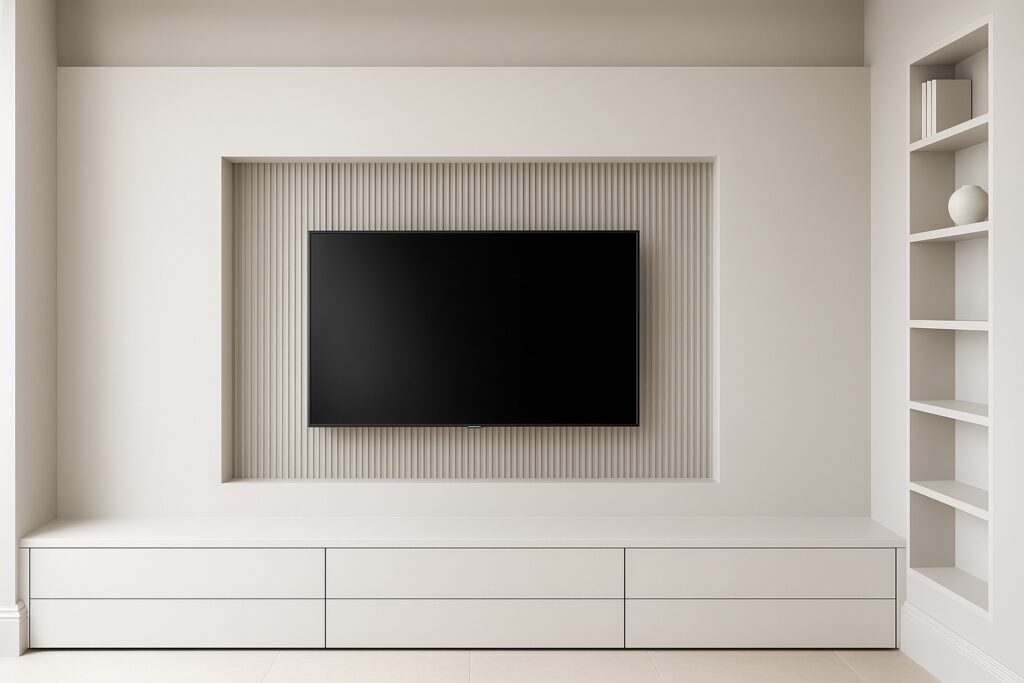


One Problem Associated With Most TV Stands in London Living Rooms
The majority of TV stand units fall into one of two categories. The first consists of furniture purchased from a shop and installed in the room — IKEA, Made, Furniture Village or any other brand currently available in high-street shops. These are ready-made items. They are produced in standard sizes and with typical finishes. They look great in the showroom, but in the actual room they can look a bit out of place, as the space wasn’t designed with their placement in mind.
The second category consists of bespoke joinery: a TV stand or media unit designed specifically for a particular room, made to its exact measurements and installed as an integral part of the space. This is a completely different product. It fits perfectly into a recess by the fireplace or into an alcove. It fits snugly against the wall. The proportions are ideally suited to the space, as they were designed specifically for it. It gives the impression that it has always been there, because functionally, that is exactly where it was meant to be.
Urban Wardrobes undoubtedly fall into the second category. Since 2012, the company has been designing and installing bespoke built-in furniture in London, with TV stands and media walls forming the bulk of the work — from a simple niche with built-in storage in Fulham to a fully lacquered media wall with built-in speakers in Chiswick, a fluted oak TV stand in Wimbledon and a minimalist built-in unit for a flat in Westminster. Each project is created from scratch, exclusively for a specific space.
This article explains why this is important, what styles are available, what costs you should expect, and what the competition is like.
| “A TV stand that blends seamlessly into a room doesn’t look like a piece of furniture. It feels like part of the architecture. That is the difference between furniture that is simply “placed” and “integrated” design.” |
Reasons to Order a Bespoke TV Stand
A fitted TV unit changes more than the appearance of a room. Many of the biggest advantages only become obvious once it’s used every day.
It Really Suits the Room
Home living rooms are not exhibition halls. They feature asymmetrically projecting fireplace recesses, alcoves whose depth varies slightly on either side, radiator pipes running along one wall, and ceiling heights that vary from room to room. A standard-sized TV stand doesn’t take all this into account. But bespoke furniture is designed with these features in mind.
In practice, this means: doors that blend harmoniously with the room’s architecture; shelves that don’t touch the skirting board; and storage units that make full use of the recess’s depth, rather than leaving empty space at the back. This is the distinction between furniture that simply sits in a house and that which forms an integral part of it.
Cable Management That Actually Works
It is this detail that matters most in everyday use, yet it receives the least attention when discussing TV stands.
In bespoke furniture, the cable management system can be integrated into the design right from the planning stage — this includes channels for power cables, HDMI cables and speaker wiring; concealed rear panels with access hatches; and sockets built into the cabinet itself, rather than scattered across the floor. Once the TV is mounted and the furniture is in place, no cables are visible. Not a single one. This is because the system for routing cables was thought through from the very beginning, rather than added as an afterthought.
Integrated LED Lighting
A well-designed TV stand with built-in lighting looks much better in a room than one without. Strip lighting along the back wall of the TV recess reduces eye strain in a dark room and creates a halo effect behind the screen. Under-shelf lighting in bookcases highlights the items on display and makes the unit stand out at any time of day. Floor-level plinth lighting visually lifts the unit — it looks less bulky and less like a piece of furniture simply standing on the floor.
Urban Wardrobes integrates LED lighting into all its TV unit and media wall designs as an integral part of the design. It’s connected to the room’s mains supply rather than being battery-powered. The brightness can be adjusted if required. The positioning of the lighting is determined by the designer at the design stage, and not added as an additional feature at the end.
Storage Space Designed With Your Actual Needs
Bespoke furniture offers the chance to solve a specific storage problem, rather than simply fitting shelves into a recess and hoping for the best. The height of the units can be tailored to specific equipment: for a 90 mm-high receiver, a shelf with 120 mm of clearance is provided. A unit for vinyl records may have exactly the right depth. The size of the drawers could be tailored to accommodate remote controls, cables and games controllers, or books, or anything else you actually need to store in the same room.
This level of customisation is only possible when the cabinet is designed from scratch specifically for the client, not selected from a catalogue.
Flexibility Regarding Budget and Space
Urban Wardrobes works with a wide range of materials across various price points — from cost-effective lacquered MDF at one end of the spectrum to natural oak burl veneer at the other — whilst the design adapts to the available space without compromise. An awkward L-shaped alcove, a basement room with unusual proportions, a fireplace recess in an open-plan living room, a wall-to-ceiling cupboard — we’ve done it all. It’s the technical brief that dictates the design, not the other way round.
| “The layout of cabling, lighting and the technical specifications of storage systems — it’s these decisions that determine whether you’ll still be satisfied with this product in five years’ time. Their effectiveness depends entirely on them being taken into account right from the design stage.” |
Styles — What’s Available and Who Each One Suits
Urban Wardrobes manufactures TV stands and media walls in all the styles currently popular in London interiors. All products are made exclusively to order. Each piece is crafted to the exact dimensions of the room. All can be fitted with built-in lighting, cable management systems and storage solutions.


| Style 1: Factory-Lacquered MDF — Any Colour The most versatile option · Contemporary, minimalist, durable · A full range of colours |
| Factory-applied finishes are the most popular choice for TV stands in contemporary London homes — and there are good reasons for this. A smooth, spray-finished surface, available in any colour from the RAL, Farrow & Ball or Little Greene colour palettes, gives you complete control over how the stand will fit into the room’s interior. It can harmonise with the colour of the walls and “blend in” with them, or it can contrast and become a focal point of the space. The choice is entirely up to the customer. Factory lacquering means that the finish is applied in a controlled spray booth prior to assembly. It’s not painted on site. As a result, the surface is significantly harder, with a more even sheen and greater resistance to scratches and impacts than any finish applied directly in place. For a TV stand in the living room — a surface that is touched, pushed and sat in front of every day — durability is of the utmost importance. Handle-free designs are particularly popular with this finish: “push-to-open” mechanisms, milled recesses in place of handles, or doors with touch-activated latches, which give the furniture a seamless, continuous surface. When the TV is the centre of attention, the furniture beneath it should take a back seat and not compete with it. Recent projects in this style include a lacquered TV wall unit with built-in speakers in Chiswick, a minimalist built-in wardrobe for a flat in Westminster, and an all-white, handle-free media wall for a living room in Fulham. |
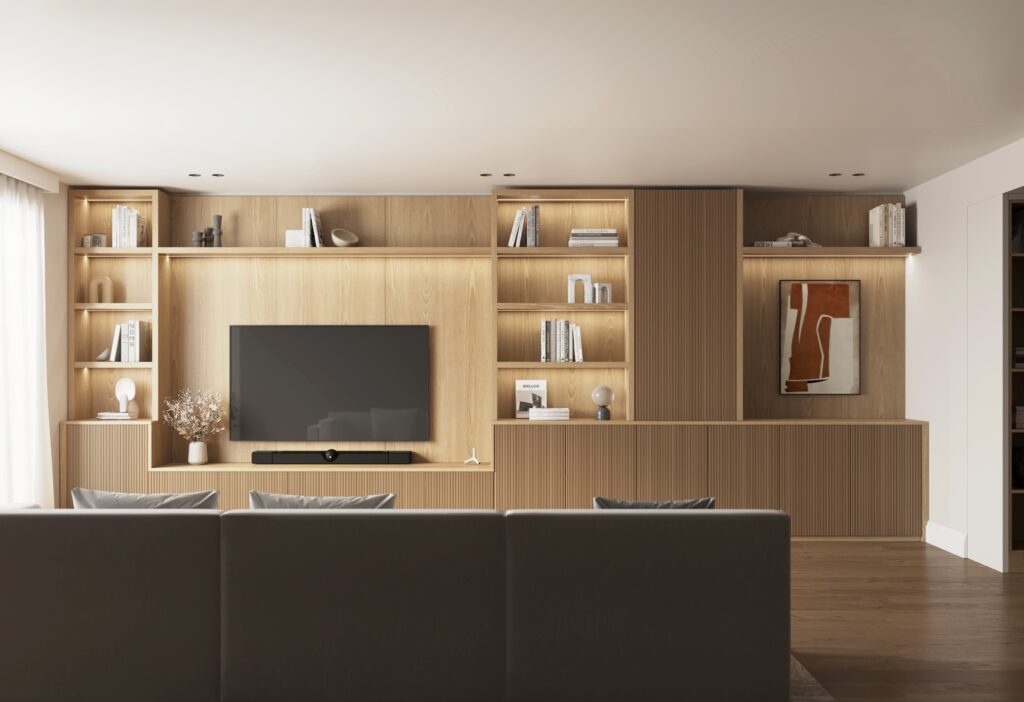
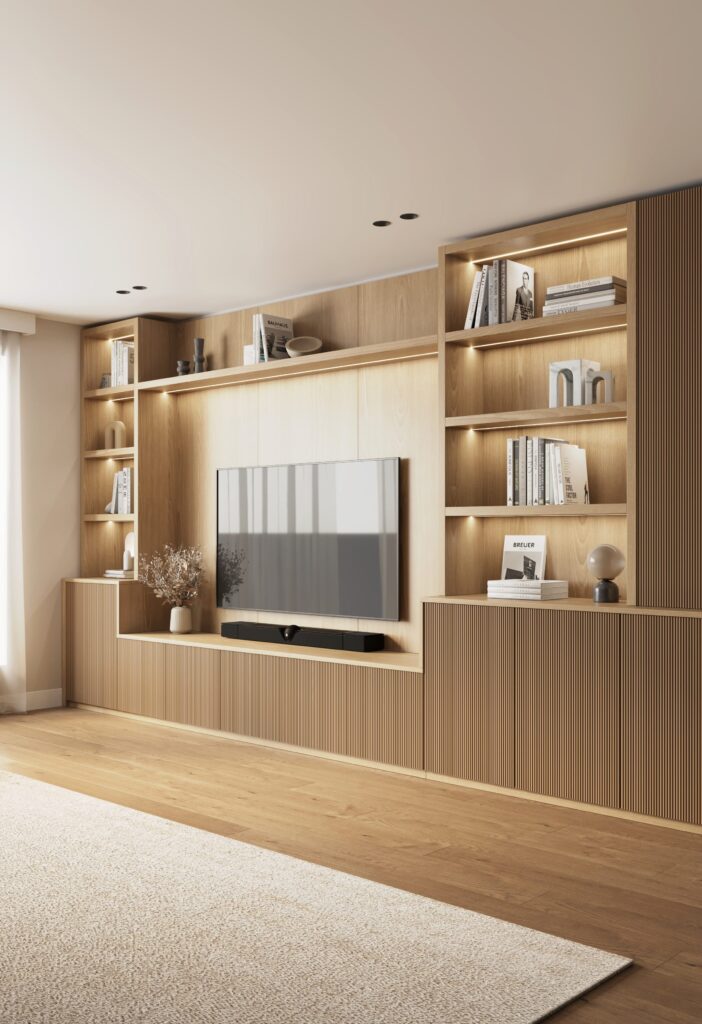
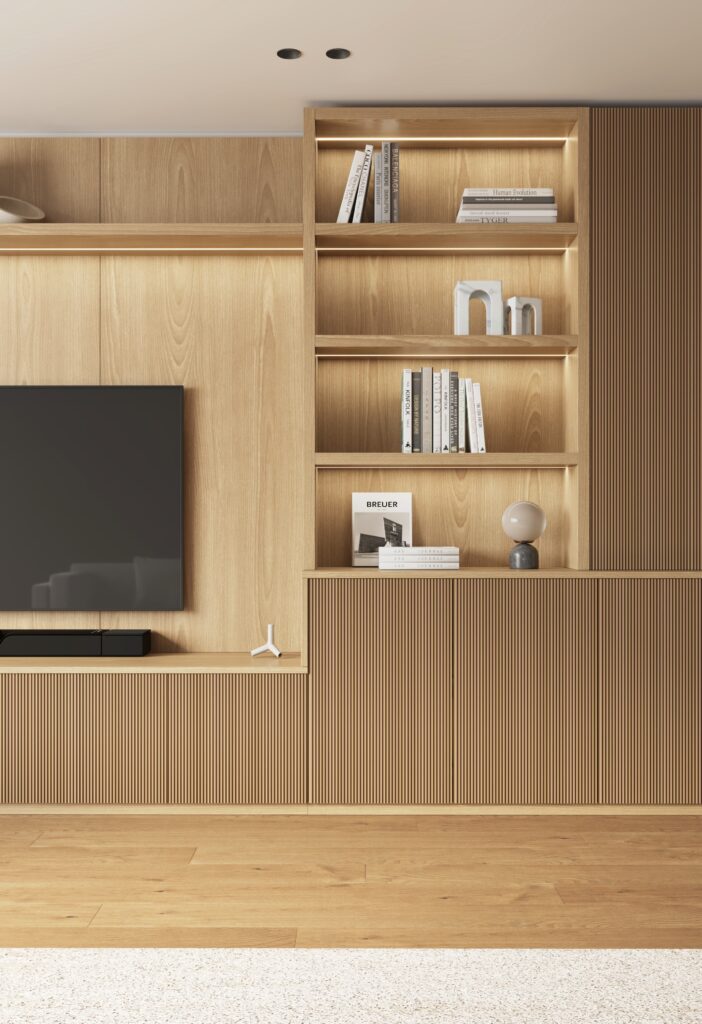
| Style 2: Fluted and Reeded Oak Panels The trendiest interior design right now · Textured, warm, distinctive |
| Currently, in London, the most popular finish for TV stands is oak with a grooved surface, and it’s not hard to see why. The vertical grooved lines reflect light differently throughout the day — the shadows shift, the surface looks different in morning and evening light, and the warmth of the oak texture adds a depth that painted MDF simply cannot replicate. Urban Wardrobes uses genuine oak veneer for its TV stands with grooved panels — this isn’t a laminated wood-grain print, but a genuine wooden surface. The grooves are machined into the front surface of the panel, creating crisp, uniform lines across the entire width of the stand. The result is a media unit that looks both contemporary and substantial — a finish that suits both a recently renovated Victorian living room and a modern open-plan flat. Recent projects include a full-width media wall in ribbed oak at Wimbledon (as part of a major refurbishment of the entire building), a TV unit with fluted oak fronts in a bespoke design for a four-bedroom flat, as well as a gloss acrylic cabinet with a TV panel made of oak slats — demonstrating how fluted oak can be combined with other materials in a mixed-finish design. Ribbed panels are also available in walnut and ash and can be combined with painted or lacquered elements to create a two-material design. The combination of a white lacquered base unit with a ribbed oak top is one of the most popular configurations today. |


| Style 3: Real Wood Veneer — Oak, Walnut, Dark Wood Premium natural material · Warmth and depth that no painted finish can match · Ages beautifully over the years |
| Natural veneer is a premium-quality material that is ideal for spaces where a TV stand needs to blend harmoniously with high-quality furniture or historic architectural features, or in interiors where the choice of materials is a key consideration. Urban Wardrobes has completed projects involving TV stands and bookcases made from wooden veneer: in oak (a bookcase project in Roehampton), dark wood (a bookcase for a living room in Fulham), oak with a diagonal grain (a combined walk-in wardrobe and living room) and walnut veneer with sliding glass doors (Canary Wharf). Each of these options has a fundamentally different aesthetic compared to the lacquered range — warmer, more pleasant to the touch and with a visual depth that only the genuine texture of wood can provide. Veneer is applied to the MDF frame during the manufacturing process, ensuring a uniform appearance across all surfaces. The finish typically involves oil or varnish, which protects the wood whilst preserving its texture. Wardrobe sections made of genuine wood with a painted interior — a common configuration — combine the warmth of the exterior material with the practicality of an interior that is easy to maintain. This style is particularly well suited to historic homes in Richmond, Chelsea, Hampstead and Holland Park, and blends harmoniously with both classic freestanding furniture and contemporary built-in furniture within the same living space. |


| Style 4: Shaker — Factory Lacquered or Hand-Painted Period-appropriate · Traditional design · Two finish options |
| The shaker-style profile on a TV stand or media wall looks harmonious in period homes for the same reason as it does on bedroom wardrobes: it draws on the vocabulary of the original architecture. Doors with concave panels and a flat frame profile are a perfect fit for Victorian and Edwardian-style living rooms, as they speak the same language as the original skirting boards, door frames and window architraves. Two finish options, just like in the bedroom collection. Factory-lacquered Shaker: finished in a spray booth for maximum durability, available in any colour. Hand-painted Shaker: applied on-site by a skilled craftsman, giving a slightly warmer and more artisanal look. Both options are available for TV stands. Shaker-style TV stands are particularly popular for niches situated on either side of a fireplace recess — a configuration found in hundreds of Victorian and Edwardian living rooms in West and South-West London. The cabinet fits the recess perfectly; the Shaker-style doors harmonise with the room’s original joinery, and the proportions look just right, as the cupboard was designed specifically for this particular recess instead of simply being fitted into it. Among the latest projects featuring painted Shaker-style furniture are built-in cupboards in Clapham, a traditional bookcase in Hampstead, and lacquered Shaker-style cupboards in several projects in Richmond and Wimbledon. |
| Style 5: High Gloss Acrylic State-of-the-art · High reflectivity · Striking finish for contemporary interiors |
| High-gloss acrylic is the most visually striking finish in this range, and is also the ideal choice for certain types of contemporary spaces where the TV stand is intended to be a striking design feature and not a discreet background element. The acrylic finish is applied during the manufacturing process and creates a depth of reflection that varnish simply cannot match. In the right setting — a contemporary flat with minimal furniture and striking architectural lines — a high-gloss acrylic TV stand looks like a piece of furniture straight out of a design gallery. In a room that already features plenty of textures and patterns, this would be too much. Urban Wardrobes has created a range of acrylic TV stands, including a combined model featuring a glossy acrylic cabinet and a TV panel made from oak slats — this combination demonstrates how this finish works best with a contrasting material that adds warmth and texture, balancing out the reflective surface. This is a specialised finish. It requires specific care and handling to maintain the quality of the surface, so it’s not suitable for a family living room with young children. However, for the right project and the appropriate client, it’s truly exceptional. |
| Style 6: Mixed Materials and Bespoke Combinations No rules · Any combinations · Flexibility in developing designs based on technical specifications, not a catalogue |
| One of the benefits of working with a craftsman who makes furniture exclusively to order is that styles are not confined to any particular framework. A TV stand doesn’t necessarily have to be made from a single material. Some of the most interesting projects carried out by Urban Wardrobes feature designs combining different materials: a lacquered base with a corrugated oak panel above the TV, a niche for the TV with an oak frame and painted storage sections at the bottom, or a combination of open shelves in natural veneer with closed cupboards featuring a contrasting lacquered finish. A complete home refurbishment in Wimbledon is a fine example: TV stands and bookcases form part of a broader furniture concept spanning several rooms, with a consistent choice of materials throughout the project. In the Chelsea project, a single room combines a bespoke office desk and TV unit — both pieces share a common material aesthetic, giving the room a balanced and finished look. Integrated elements can be added to any style: built-in columns (as in the lacquered TV wall in Chiswick), a bar section as part of the living room furniture (as in the lounge bar and storage system project in Wembley), or a combined TV unit and bookcase (as in the oak-veneer bookcase project in Roehampton). The brief sets the direction, and the design follows suit. |
| “Custom-made TV cabinet, designed for a recess 1,847 mm wide and 2,340 mm high, fits perfectly into this recess. The cabinet from the catalogue is suitable for recesses between 1,800 mm and 2,000 mm wide. In a real room, you notice this difference every day.” |
Why Urban Wardrobes Are the Leading Experts in TV Stand Installation in London
The competitive advantages of Urban Wardrobes over its rivals can be summarised in five points. Each of these is a concrete fact, not a marketing slogan.
- Real tailor-made work. Manufactured to specification from scratch — this isn’t a typical modular set that’s simply adapted to fit the space. Every dimension has been carefully selected precisely for the particular room.
- Absolutely flexible in terms of budget and finishes. A wider choice of styles and materials than any other London-based bespoke furniture manufacturer in this price range — from cost-effective decorative panels to natural oak and walnut veneers.
- Properly implemented integrated features. Options for integrated LED lighting, cable management systems and built-in speakers are all available — these were all planned at the design stage, rather than added later.
- Work experience across the whole of London. Projects completed in Chiswick, Chelsea, Wimbledon, Westminster, Fulham, Hampstead, Holland Park, Canary Wharf, Battersea, Kensington, Paddington and other areas. Know everything about London homes.
- Own team, in-house production. Manufactured in London, installed by the company’s own crew, with most projects completed within 4–8 weeks. No subcontractors involved, no surprises on the day of installation.
Competitor Comparison Overview
There are other options for TV stands and media walls in London — both ready-made and bespoke. Here is an impartial review of each of them.
| IKEA BESTÅ and PAX CombinationsOption with a kit of parts — suitable for some budgets, but not appropriate for most spaces |
| IKEA’s BESTÅ range is a well-designed modular TV stand system. The configurations are logically structured, the finish is quite decent for this price range, and companies such as Superfront and others offer upgraded fronts, which make the end result look considerably better than the basic product.The main problem is that BESTÅ is a modular system. The modules come in standard sizes, with the same height and depth. In a room where a recess or wall happens to match the dimensions of the IKEA modules, everything can look almost perfect. In a place where this isn’t the case — and that’s the majority of London flats — cracks appear, proportions are off, and there’s an undeniable sense that the furniture was chosen on a budget instead of being designed specifically for that room.Cable management is a secondary concern. Built-in lighting requires a separate purchase and DIY installation. The materials are, by design, budget-friendly. For a first flat or a rented property, where costs need to be kept to a minimum, IKEA is a good fit. For your own home, which you plan to keep for the long term, it’s a compromise that you’ll see every day. |
| High Street / Online Furniture (Made, Furniture Village, Ercol, Etc.)Quality products, incorrect category — these are freestanding pieces of furniture, not built-in ones |
| Made, Furniture Village and similar shops offer truly high-quality freestanding TV stands across various price ranges. The quality of design has improved significantly in recent years, and some of these products look attractive and are beautifully crafted.But these are freestanding pieces of furniture, not custom-built. They simply sit in the room rather than being an integral part of it. Their proportions are universal — designed to look good in a wide range of spaces, but not specifically in yours. And in London living rooms with alcoves by the fireplace and non-standard wall widths, a freestanding sideboard always gives itself away: it ends up being too wide, too narrow, or leaves a gap at the sides that looks exactly as it appears.For clients who want a sideboard that looks as though it’s an integral part of the living room, freestanding furniture is the wrong choice. |
| Local Carpenters and Independent Woodworking ShopsHigh skills, less support when it comes to design — a lot depends on the individual |
| There are plenty of skilled independent joiners in London who can craft a TV stand or bookcase to a high standard. For a client who knows exactly what they want, has a clear set of specifications and is prepared to play an active role in the process, a skilled local joiner can be a good option.Drawbacks: less support with design matters, often no showroom where you can view the materials in person, and less consistency in the final result when carrying out complex commissions. A well-thought-out joinery project — featuring integrated lighting, built-in speakers, a cable routing system designed from the outset, and a factory-applied lacquer finish or a ribbed oak finish — requires a level of design process and production infrastructure that most individual joiners cannot provide. The result depends to a large extent on the individual craftsman, their experience with that particular finish, and whether the finish is applied on-site or in a professional paint shop.Urban Wardrobes occupies a middle ground between a bespoke joiner and a large national company — it’s a small, specialist London-based team with a well-established design process, its own production workshop and experience in delivering complex TV cabinet projects with high technical requirements. |
| National Bespoke Furniture Chains (Sharps, Hammonds)Their main specialisation is wardrobes; TV stands are merely a secondary line of business, not their main expertise |
| National chains — such as Sharps, Hammonds and similar retailers — are, by their very nature, companies specialising in the manufacture of wardrobes. Some of them offer TV stands or media walls as part of a broader room design, but these aren’t their core products. The design process for TV stands is less sophisticated, the finish options are more limited, and the end result reflects this.Modular systems form the basis for national chains, which imposes the same constraints on TV stands as on wardrobes: standard sizes, approximate fittings and a final result that looks exactly as it’s supposed to. For a buyer who wants a TV stand that forms part of a wider project involving fitted wardrobes from a single supplier, this may make sense. For a standalone TV stand project, however, Urban Wardrobes would be the better choice. |
| “Managing cables isn’t exactly a thrilling task. Neither is choosing the right shelf height for your receiver or routing the wiring for your LEDs correctly. But it’s these decisions that determine whether, three years down the line, this system will still be a pleasure to look at, or whether it will become a source of minor daily annoyance.” |
Frequently Asked Questions — Straight Answers
| How much does a bespoke TV stand cost in London? |
| Prices start from £2,500 + VAT per project. The cost of a single TV unit made from lacquered MDF, featuring shelves and a closed cupboard at the bottom, is typically between £2,500 and £4,000. A complete media wall with built-in lighting, a cable management system and a combination of materials — for example, lacquered MDF with grooved oak panels — usually costs between £4,000 and £8,000, depending on size and specifications. Real wood veneer and more complex configurations fall within the higher price range. Urban Wardrobes provides a detailed, itemised quote following a design consultation – without any hidden costs. |
| Is it possible to install a TV stand in the niche near the fireplace? |
| Yes — this is one of the most common requests received by Urban Wardrobes. Victorian and Edwardian living rooms almost always feature two alcoves, situated on either side of the fireplace. These are ideal locations for built-in TV units and bookshelves. The furniture is made to the exact dimensions of each recess (which rarely match), from floor to ceiling, with built-in lighting and a cable management system. |
| Can the TV be wall-mounted within the unit? |
| Yes. The TV recess is designed to accommodate wall-mounting brackets, with a cable duct running through the rear panel and connecting to a power socket and an HDMI port concealed inside the cabinet. The result is a TV that seems to “hang” in mid-air, with no visible cables — this is the standard configuration for most Urban Wardrobes TV cabinet designs. |
| Could built-in speakers be fitted into a TV stand? |
| Absolutely. Urban Wardrobes has produced TV stands with built-in speakers — the speaker enclosures are integrated into the stand’s frame during manufacture, and the speaker cables are routed inside the structure. One example is the lacquered “Chiswick” wall-mounted TV stand with built-in speakers. To achieve this, the technical specifications of the speakers must be agreed upon at the design phase. |
| How long does it take to install a TV stand? |
| Most TV stand and media wall installations are completed in a single day. Design and manufacture take 4–8 weeks — from project approval to installation. All installation work is carried out by Urban Wardrobes’ own installation team — without the use of subcontractors. |
| Do you work with interior designers and architects? |
| Sure — Urban Wardrobes regularly collaborates with interior designers and architects across London. Its specialists have experience working with design drawings and technical specifications and can prepare working drawings for approval by the designer before production begins. This is a standard part of the process when working on projects. |
Concluding thoughts
When you’re looking for the best TV stand fitters, contractors or companies in London, the right choice is a company that creates furniture “from scratch” specifically for your room, adhering to design principles that ensure lighting, cabling and storage systems are integrated correctly right from the start. This is exactly what Urban Wardrobes has been doing since 2012, working with interiors of any style in London and across any price range suitable for bespoke furniture.
The process begins with a design consultation. Representatives from Urban Wardrobes will visit your premises, take measurements, discuss your requirements and return with a design proposal and a detailed quotation. The showroom at Unit G02, 111 Power Road, Chiswick operates by appointment only — there you can view samples of materials and finish options in person. The company operates in London.

