

Fluted, Reeded, Slotted, Ribbed, Grooved: The Complete Guide to Decorative Wall Panels
Every type of panel on the UK market explained — from £50 acoustic slatwall to £250/sqm solid wood, what you actually get, and what you don’t
If you’ve been looking for at fluted panels, reeded panels, slatted walls, ribbed cladding – whatever you want to call them – you’ve probably noticed something. They are literally everywhere in 2026. And all of them looking roughly similar in photographs, but the price difference between the cheapest and most expensive is about tenfold.
That’s a big gap. And it’s not obvious from a product listing why one panel costs £50 and another costs £250 per square metre. They both have vertical grooves. They both look nice in a styled room shot on Instagram or Pinterest.

But they’re not the same product. Not even remotely. The material, the construction, the finish quality, the longevity, the feel when you actually touch them, how they look from two metres away versus two centimetres — all of it is different. And if you’re about to spend money putting panels on a wall or into a piece of bespoke furniture, understanding those differences before you buy will save you from the kind of regret that’s expensive to fix.
In this guide we would like to review every type of decorative panel available in the UK right now and discuss the different in quality and price. We’ll go through each category honestly – what it is, what it costs, what it’s good for, and where it falls short. No sales pitch. Just the practical information you need to make the right choice for your project.
First — Let’s Sort Out the Terminology
A lot of people in 2026 genuinely confuse the naming around these. What actually happens is people use “fluted”, “reeded”, “ribbed”, “slatted”, “slotted”, and “grooved” almost interchangeably online, and, to be honest, most of online suppliers mix them up. This is where most people get it wrong as they do mean slightly different things, and knowing the difference helps when you’re comparing products.
Fluted — concave channels. The grooves curve inward, creating a series of scooped-out valleys. This is the original architectural profile — Greek and Roman columns used fluting with 20 or 24 vertical concave channels running the height of the column. In panels, fluting creates shadow lines that shift through the day as the light moves. It’s the most classical reference.

Reeded — convex ridges. The opposite of fluting. Instead of channels scooping inward, reeded profiles have rounded ridges that push outward. The effect is bolder and more tactile — you can feel the rounded tops under your fingers. Reeded panels tend to look more contemporary than fluted because the light moves across them and create stronger visual rhythm.
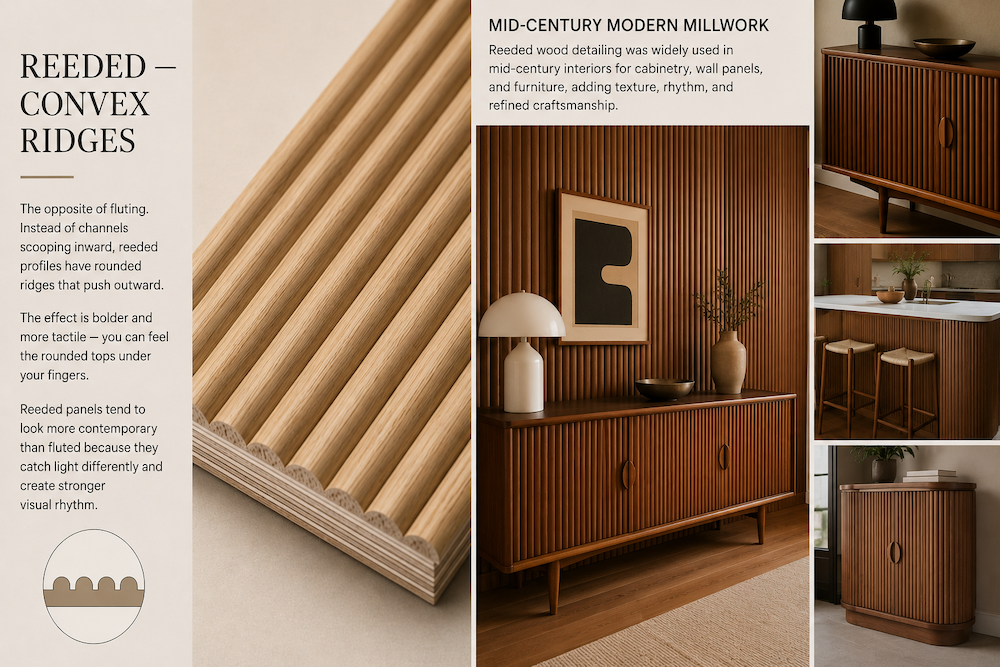
Ribbed — essentially the same as reeded in most commercial contexts. Some manufacturers use “ribbed” to mean angular or triangular ridges rather than rounded ones, but honestly the terms overlap so much that you need to look at the profile drawing rather than trust the name.
Slatted / Slotted / Slatwall — individual slats with visible gaps between them. Unlike fluted or reeded panels where the surface is continuous, slatted panels have separate strips of material — usually MDF with a veneer — mounted on a backing with air gaps in between. The acoustic slatwall panels are the best-known version of this: oak veneer slats on black polyester felt backing.

Grooved / V-Groove — cut channels on a flat surface. V-groove panels have sharp V-shaped lines cut into a flat board at regular intervals, creating the appearance of individual planks without actual separate pieces. This is the tongue-and-groove or shiplap-adjacent category — a different aesthetic from the rounded profiles of fluted and reeded panels.
In reality, the term “fluted” has become the generic catch-all for all of these profile types in the UK market. If someone says “fluted wall panel” they might mean any of the above. So when you’re comparing products, always look at the actual cross-section profile, not just the name.
| “Fluted, reeded, ribbed, slatted, grooved — five different words, five different profiles. The name on the listing doesn’t always match the product. Look at the cross-section.” |
Where Fluting Actually Comes From
So here’s the thing about fluting. It isn’t a recent trend. It’s one of the oldest decorative techniques in architecture.
It’s a common knowledge that The Greeks used it on their temple columns from around the 7th century BC. Doric columns had 20 vertical concave channels. Ionic columns had 24. The channels served an optical purpose — they made the column appear taller and slimmer, and they created moving shadow lines that gave the stone a sense of life as the sunlight shifted across it during the day.
Funny thing is that The Romans used it too, though less obsessively. It essentially disappeared during the medieval period, came back during the Renaissance, and then became extremely popular again in neoclassical architecture — which is why you see fluted columns and pilasters in so many Georgian and Regency buildings in London. The detail has been part of English architectural vocabulary for centuries.
The current revival in interior design draws on that heritage but applies it differently. Instead of stone columns, it’s wall panels. Instead of carved marble, it’s MDF, veneer, and solid wood machined on CNC routers. But the underlying principle — using vertical linear profiles to create depth, shadow, and visual rhythm on a flat surface — is exactly the same idea the Greeks had 2,700 years ago. And this is where the history matters because this is why fluted and reeded surfaces look “right” to most people in a way that’s hard to articulate. Basically, the proportions are embedded in Western architectural tradition. Put simply – it’s not a passing trend. It’s a design language that has survived millennia because it works.
The Five Types of Panel on the UK Market
Let’s go through each category in order of price, starting from the cheapest.
Type 1: Acoustic Slatwall Panels (The Entry-Level Option)

You’ve probably seen this one everywhere – Instagram, Pinterest, interior design journals, Google pics etc.. If you just scroll those websites for “fluted wall” and 80% of what you’ll see is this product. This trend became hugely popular in the UK in the last three years, with suppliers like NatureWall, Acupanel (The Wood Veneer Hub), SlatPanel, Slat Solution, and The Wall Exchange all selling essentially the same thing. The only difference is the pictures, price and the way they do marketing for the product. But it’s the same product – simple as that.
What it is
Individual MDF or chipboard slats which are typically around 12mm wide and have a thin layer of real wood veneer (usually oak or walnut) glued to the face. These slats are bonded to a backing sheet of black recycled polyester felt, which is as a rule about 9mm thick. The felt gives the panel its acoustic properties and creates the dark shadow lines visible between each slat.
Standard panel sizes are 2400 x 600mm or 1200 x 600mm. You fix them to the wall with grab adhesive or screws through the felt backing. They’re lightweight and relatively easy to install. And if you are a competent DIYer, you can do it without any problems.
What it costs
From what we can see these days, the cost of the panel is usually between £50 and £100, depending on the supplier and whether there’s a current promotion. That makes it by far the cheapest option for getting a “slatted wall” look. Which means per square metre, you’re looking at roughly £35–£70. From our experience, there is no way you can find a cheaper option on the market.
The good
Clearly, the price is the main attraction. For under £200 you can cover a feature wall behind a bed or a TV. It’s always available in stock. It comes in several colour options: natural oak, grey oak, smoked oak, walnut, dark walnut, even black-stained oak. The acoustic felt does genuinely absorb some sound, which especially matters in rooms with hard floors and bare walls where echo can be a problem. And it looks arguably decent from two or three metres away. It also looks relatively good on the pictures and video. The oak veneer reads as real wood because it is real wood, just a very thin layer of it.
The not so good
Try to get closer and the quality shows. The slats aren’t edge-banded. That means the sides of each individual slat — the left and right edges — are raw, exposed MDF. Basically, you can see it if you look at the panel from an angle. It’s not a clean, finished edge. It’s brown MDF or chipboard core visible between the veneer face and the felt backing.

The veneer itself is very thin — typically 0.3mm to 0.5mm. That’s usually fine for a wall panel that nobody touches, but it won’t survive a scratch or a knock. And if the veneer chips, there’s no repairing it — the MDF underneath is immediately visible.
The colour options, while decent, are pre-set. You won’t’ be able stain or lacquer these panels in a custom colour because the veneer already has a factory-applied finish. If you want sage green or charcoal, this product doesn’t work.
The other thing important to know: with the felt backing being black, every gap between slats reads as a dark line. That’s the look. Some people love it. But from our experience definitely not everyone. So if you want the panel effect without the dark gaps, you need a different product for sure.
| Acoustic slatwall panels — quick summary: Price: £50–£100 per panel (cheapest option available). Material: MDF slats with thin oak or walnut veneer on recycled PET felt backing. Sizes: typically 2400×600mm or 1200×600mm. Finish: pre-finished — limited to manufacturer’s colour range. Pros: cheap, always available, genuine acoustic benefit, looks fine from a distance. Cons: not edge-banded (raw MDF visible on slat sides), very thin veneer, can’t be custom-coloured, looks budget if stay close. Best for: quick feature walls on a budget, rental properties, rooms where the panel won’t be touched or closely examined. |
Type 2: Fluted MDF Panels (The Paintable Option)
This is the workhorse of the panel world. No veneer, no felt, no pretence of being wood. It’s MDF with a profile machined into it by a CNC router. Honest, functional, and entirely dependent on what you do with it afterwards.
What it is
A sheet of MDF — usually 18mm to 25mm thick — with a repeating fluted, reeded, or ribbed profile machined into one face. The profile is continuous — no gaps, no felt backing, no acoustic properties. It’s one solid piece of material with a three-dimensional surface.
The profiles vary by manufacturer. Some offer standard fluted (concave channels), some do reeded (convex ridges), some do a triangular or peaked profile, and some offer more unusual shapes. Suppliers like CNC Creations, NatureWall (their Legacy range), and JustMDF offer several profile options and they can offer production of custom profiles if you’re ordering enough.
What it costs
The raw panel costs anywhere from £50 to £100. The catch is the following: that’s the cost of an unfinished panel. It arrives raw. You have to finish it. And how much that finishing costs depends entirely on what finish you want and also operational/logistics costs involved.
Finishing options that matters
Hand painting on site is the cheapest option. You can genuinely do it yourself with a roller and brush, or pay a decorator. Two coats of eggshell over a primer. It’ll look fine from a distance, but up close you’ll see roller texture in the flutes, possibly brush marks in the channels, and the finish won’t be as hard or durable as lacquer.
Spray lacquer in a factory is the quality option. The panel gets primed, sanded, and sprayed in a controlled spray booth — consistent temperature, no dust, proper cure time. The result is a smooth, hard, uniform finish that looks sharp and holds up to daily contact. But it’s expensive. The fluted profile creates complications — every channel needs to be properly covered, edges need polishing, and sanding between coats on a textured surface is slow, careful hand work. Factory lacquer on a fluted MDF panel can easily add £100–£200 to the cost of each panel.
So the “cheap” MDF panel isn’t necessarily cheap by the time it’s done properly. But the upside is significant: you can have any colour. Literally any colour — RAL, Farrow & Ball, Little Greene, a custom match from a fabric swatch. That’s something none of the pre-finished veneer products can offer.
Subtypes and profiles
Fluted MDF comes in several profile variations. The main ones are:
Standard fluted: Concave channels, evenly spaced. The classic look. Produces clean shadow lines and a refined, classical feel.
Reeded (convex): Rounded ridges that push outward. Bolder, more tactile. Light moves across them in a different way and it feels more contemporary.
Tongue and groove / V-groove: Sharp V-shaped lines cut at intervals into a flat face, creating the appearance of individual planks. More traditional, heritage-inspired. Popular for country-style kitchens and period-property bedrooms.
Triangular / peaked: Angular ridges with sharp peaks. Creates dramatic geometric shadow patterns. More directional and modern — often used in feature walls and media walls.
Chamfered: Flat-topped ridges with angled cuts between them. A softer, less pronounced version of the triangular profile. Works well where you want texture without it taking the room.
The honest assessment
The big advantage of fluted MDF is flexibility. Any profile, any colour, any size — most CNC shops will cut panels to your exact dimensions. For fitted furniture — wardrobe doors, media walls, kitchen cabinets — this is the material that gets used when you want a specific painted colour with a fluted or reeded profile.
The downside is that it has no wood grain. None. When it’s painted, it’s a plain coloured surface with a three-dimensional profile. That’s either exactly what you want (a clean, architectural look where the colour and the profile do the work) or it’s not enough for you (you want to feel character of real woodgrain visible). There’s no compromise here — MDF is MDF.
| Fluted MDF panels — quick summary: Price: £50–£100 per panel (unfinished) + finishing cost (£50–£200 per panel depending on method)Material: solid MDF, CNC-machined profile, no gaps between ridgesProfiles: fluted, reeded, ribbed, V-groove, triangular, chamfered — multiple optionsFinish: unfinished — hand paint, spray, or factory lacquer in any colourPros: any colour, any profile, any size, good for fitted furniture and bespoke projectsCons: no wood grain (plain painted surface), finishing adds significant cost, no acoustic benefitBest for: painted fitted wardrobes, kitchen cabinets, media walls — projects where colour matters more than wood grain |
Type 3: Pre-Finished Reeded Veneer Panels (The No-Gap Middle Ground)
This one sits between the budget acoustic slatwall and the premium solid wood option. It looks better than the slatwall up close, it doesn’t have the dark gaps between slats, and it comes ready to install. The trade-off is limited customisation.
What it is
A rigid MDF panel with a thin engineered veneer layer bonded to the face, machined into a reeded or fluted profile. The main difference from the acoustic slatwall is that the surface is continuous — no gaps, no felt, no exposed slat edges. The ridges sit flush against each other, and create a smooth, more refined look.
Standard sizes are the same as the slatwall — 2400 x 600mm or 1200 x 600mm. The veneer is pre-finished with a protective lacquer already applied.
What it costs
Around £100 per panel. A step up from the cheapest slatwall but still solidly in the affordable category. The fact that it comes pre-finished means the panel price is the final cost — no spray booth, no painting, no extra labour.
The good
It looks noticeably better than the acoustic slatwall when you’re right in front of it. The continuous surface looks more expensive. The reeded profile has a cleaner, more furniture-like quality. The veneer gives you real wood grain look — oak or walnut, depending on what you choose — adds a warmth and statement that painted MDF can’t match.
And the no-gap thing genuinely changes the look and feel. Without the dark felt lines between slats, the panel reads as a solid textured surface rather than a series of separate strips. Some people strongly prefer this — it feels less “trendy” and more timeless.
The limitations
The veneer layer is very thin. We’re talking fractions of a millimetre. It’s a real wood surface, but there’s almost nothing there. A hard knock or a scratch will go straight through to the MDF substrate.
And because the panels come pre-finished with a protective lacquer, you can’t easily change the colour. The lacquer resists stain. If you want the panel in sage green or charcoal or anything other than natural oak or walnut, this product doesn’t work. You’re limited to whatever colours the manufacturer offers, and that’s usually a range of about four to six natural wood tones.
It’s a good product for what it is. But “what it is” is a pre-made panel in a pre-set colour at a mid-range price. If your project needs anything custom, you’ll need to look at Type 2 or Type 4.
| Pre-finished reeded veneer panels — quick summary: Price: ~£100 per panel (final cost, no finishing needed)Material: thin engineered veneer on MDF core, continuous reeded profile, no gapsSizes: typically 2400×600mm or 1200×600mmFinish: pre-finished with factory lacquer — limited colour range (oak, walnut, grey oak etc.)Pros: better close-up quality than slatwall, no dark gaps, real woodgrain look, ready to installCons: very thin veneer, can’t be custom-coloured (lacquer resists stain), limited to manufacturer’s paletteBest for: feature walls where you want a cleaner look than slatwall without the cost of solid wood — and where the available colours work for your scheme |
Type 4: Solid Wood Fluted and Reeded Panels (The Premium Option)

This is the one that changes everything. When you move from veneer-on-MDF to actual solid wood, the difference is huge. It’s visible, it’s tactile, and it’s immediately apparent to anyone who touches the surface.
What it is
Real solid wood — oak, ash, or walnut, typically — machined into a fluted or reeded profile. The wood is usually between 4mm and 9mm thick, which sounds thin but is many times thicker than the veneer on the budget panels. At 4–6mm it’s enough to see and feel real grain depth. At 9mm you’re into proper solid-wood territory where the material has genuine structural presence.
The panels are CNC-machined from solid timber blanks. The profile is cut into the face of the wood, producing channels or ridges with the grain running through every curve. That’s the critical difference — the grain is visible on every surface of every ridge, not just on a flat face. When you run your hand over a solid oak reeded panel, you feel actual oak grain on the tops of the ridges, in the valleys, everywhere. It’s incomparably better.
What it costs
Unfinished material starts from around £250 per square metre. That’s significantly more than the other options — roughly five to eight times the cost per square metre of acoustic slatwall. Finishing (staining, lacquering) adds to that. For a fully finished, installed feature wall in solid oak, you’re looking at a serious investment.
But the quality gap justifies the price for anyone who’s seen both products in person. A photograph makes a £60 slatwall panel and a £250/sqm solid oak panel look similar. Standing in front of them, touching them, seeing how light beahves across the real grain versus the veneer — there’s no comparison.
The wood species
Oak is the most popular choice. Open, characterful grain with a natural warmth that can be seen even from across a room. Oak takes stain well and can be finished in anything from a pale Scandinavian wash to a deep ebonised black. It’s the safe choice in the best sense — hard to get wrong.
Ash is lighter in colour with a straighter, more subtle grain. It has a slightly cooler tone than oak, which works beautifully in contemporary, minimalist spaces. Ash takes stain exceptionally well — the grain absorbs colour evenly, producing very clean results.
Walnut is the richest option. Deep brown tones with complex, swirling grain patterns. Every panel looks slightly different because walnut grain is naturally dramatic. Against a light wall or paired with pale furnishings, walnut fluted panels create an immediate focal point that feels luxurious without being ostentatious.
CNC profiles and bespoke options
This is where solid wood panels pull away from everything else on the market. Because the material is machined on a CNC router, the profile options are essentially unlimited. The machine uses interchangeable cutting heads — each one producing a different cross-section shape.
The standard profiles you’ll find from most suppliers include: half-round (the classic reeded look), cove (concave fluting), ogee (an S-curved profile with a concave arc flowing into a convex arc — very classical), bead (a full rounded ridge), and flat-channel (a sharp, geometric groove between flat ridges).
But for bespoke projects, any profile is achievable. You commission a custom CNC cutting head — machined to whatever cross-section shape you want — and the router will reproduce that profile across the full panel. This is the territory of architectural joinery and high-end interior design: projects where the client or the architect has specified a particular profile that doesn’t exist as a standard option. The cutting head is a one-time investment, and after that, the profile can be reproduced on any quantity of panels.
Flexible panels for curves
One capability that only exists with solid wood panels at the thinner end of the range: flexibility. At 6mm or 9mm thickness, solid wood panels can be bent around curves. Not tight curves — most products specify a minimum bend radius of around 450mm to 900mm, depending on the the grain direction — but gentle curves, columns, rounded corners, and feature walls with a bow or undulation.
This is a genuinely unique application. No other panel type can do this. Acoustic slatwall is rigid. MDF is rigid. PVC can technically flex but the quality is poor. Only solid wood at 6–9mm allows you to wrap a fluted profile around a curved surface and keep the quality and grain integrity of the material at the same time.
For projects involving curved walls, rounded columns, or furniture with a convex or concave face — reception desks, bar fronts, freestanding kitchen islands — this option works properly.
Finishing and customisation
Solid wood takes any finish. That’s one of its fundamental advantages.
A clear lacquer lets the natural grain speak. Oil finishes penetrate the wood and create a matte, tactile surface that feels warm and natural under the hand. Stains can shift the colour to anything you want — from a light Scandinavian wash through mid-tone grey to deep charcoal or near-black ebonised finishes. The grain remains visible through the stain, which gives the colour depth that painted MDF simply can’t match.
Coloured lacquer over stain produces the most refined finish — a specific colour with wood grain still reading underneath. This is the kind of finish you see in high-end furniture showrooms and five-star hotel interiors. It’s not cheap to achieve, but the result is genuinely exceptional.
| Solid wood fluted and reeded panels — quick summary: Price: from £250 per square metre (unfinished) + finishing costMaterial: solid oak, ash, or walnut, 4–9mm thick, CNC-machined profilesProfiles: half-round, cove, ogee, bead, flat-channel, plus fully bespoke options with custom CNC headsFinish: unfinished — clear lacquer, oil, stain, coloured lacquer, or any combinationFlexible: yes, at 6–9mm thickness — can wrap around curves (min. radius ~450–900mm)Pros: real wood grain on every surface, any colour, any profile, can do curves, best close-up quality by farCons: most expensive option, requires professional finishing, longer lead time for bespoke profilesBest for: bespoke fitted furniture, high-end wardrobes, feature walls, media walls, curved applications, any project where quality and material authenticity are the priority |
| “Solid wood costs five to eight times more than acoustic slatwall per square metre. Stand in front of both and you’ll understand why.” |
Type 5: PVC and WPC Panels (The Synthetic Option)
We need to include this category because it exists and some people will consider it. PVC (polyvinyl chloride) and WPC (wood-plastic composite) panels are the fully synthetic alternative to everything above. No real wood involved at all.
What they are
PVC panels are moulded plastic sheets with a fluted or ribbed profile pressed into the surface. The “wood” appearance comes from a printed film applied to the face — a photograph of wood grain, essentially, laminated onto plastic. WPC panels are similar but made from a blend of wood fibres and plastic resin, which gives them slightly more substance and a marginally more convincing surface texture.
Both types are lightweight, waterproof, and cheap. Standard sizes are similar to the other panel types — typically around 2400 x 300mm or 2400 x 600mm. They clip together with an interlocking system and can be installed by anyone with basic DIY ability.
What they cost
Between £20 and £60 per panel. The cheapest option available. Per square metre, PVC panels can cost as little as £15–£25 — a fraction of everything else on this list.
The honest assessment
In person, they look like plastic. There’s no getting around it. The printed wood grain has a uniform, the same patter over and over that doesn’t vary panel to panel the way real veneer or solid wood does. The surface feels synthetic to the touch — smooth in a way that wood never is. Under certain light angle, you can see the sheen of the plastic film.
They’re not paintable in any meaningful sense. You’re limited to whatever colours and patterns the manufacturer offers.
That said, they’re genuinely waterproof, which gives them a clear use case. In bathrooms, utility rooms, rental properties, or commercial spaces where moisture is a concern and the budget is tight, PVC or WPC panels make practical sense. They won’t warp, they won’t swell, they wipe clean.
But for a living room feature wall, a bedroom, a media wall, fitted wardrobes, or any application where you’re trying to create a quality interior — honestly, they’re not the right product. The cost saving isn’t worth the visible quality drop.
| PVC and WPC panels — quick summary: Price: £20–£60 per panel (cheapest option overall)Material: moulded PVC or wood-plastic composite with printed grain filmFinish: factory-applied printed film — not paintable, limited optionsWaterproof: yes — the only fully waterproof option on this listPros: cheapest, waterproof, easy to install, low maintenanceCons: looks and feels synthetic, printed grain pattern, not paintable, poor acoustic properties, can warp near sources of heatBest for: bathrooms, utility rooms, rental properties, commercial spaces with moisture concerns — not for quality residential interiors |
Worth Mentioning: Fluted and Reeded Glass
This isn’t a wall panel category, but it comes up so often in the same conversations that it’s worth a note.
Fluted glass — also called reeded glass or ribbed glass — is textured glass with vertical linear ridges pressed into its surface during manufacturing. The glass is made by passing molten glass between metal rollers that imprint the pattern. The result is a translucent panel that obscures what’s behind it while letting light through, creating privacy without darkness.
In fitted furniture, fluted glass gets used for wardrobe doors, display cabinet fronts, room dividers, and kitchen cabinet doors. It works well with fluted wood panels. The vertical rhythm carries through materials and the there is a feeling like it belongs together.
The main thing to know: the terms “fluted”, “reeded”, and “ribbed” are used even more loosely with glass than with wood panels. Broadly, fluted glass has concave grooves, reeded glass has wider linear channels, and ribbed glass has convex ridges — but manufacturers use all three terms interchangeably. If you’re specifying glass for a project, always request a sample or a profile drawing.
Side-by-Side Comparison
| Acoustic Slatwall | Fluted MDF | Reeded Veneer | Solid Wood | PVC / WPC | |
| Price per panel/sqm | £50–100/panel | £50–100 + finishing | ~£100/panel | From £250/sqm | £20–60/panel |
| Material | MDF slats + veneer | Raw MDF | Thin veneer on MDF | Solid oak/ash/walnut | Plastic composite |
| Finish | Pre-finished veneer | Unfinished (paintable) | Pre-finished lacquer | Unfinished (any stain/lacquer) | Factory colour film |
| Acoustic benefit | Yes (PET felt) | No | No | No (unless felt-backed) | No |
| Colour options | Limited (oak/walnut) | Any (you paint it) | Limited | Any (you stain/lacquer it) | Limited |
| Wood grain visible | Yes (veneer) | No | Yes (veneer) | Yes (real solid) | No (printed) |
| Edge quality | Not edge-banded | Clean CNC edges | Clean | Excellent | Factory moulded |
| Curved applications | No | No | No | Yes (6–9mm flexible) | Yes (thin sheets) |
| Close-up quality | Budget | Depends on finish | Decent | Excellent | Cheap |
| Best for | Quick accent walls | Painted furniture/walls | No-gap look on budget | Bespoke furniture/walls | Wet rooms, rental |
Where Each Panel Type Works Best
Feature walls
All five types can go on a wall. The question is what the wall is for and how close people will get to it. A wall behind a bed — seen from across the room, rarely touched — can work fine with acoustic slatwall or reeded veneer. A wall in a hallway or a living room where people walk past and brush against it — solid wood or well-lacquered MDF is a better call.
Fitted wardrobe doors
This is where material quality matters most. Wardrobe doors get touched multiple times a day, every day, for years. Acoustic slatwall won’t work here — the felt gaps would collect dust. Also, the super-thin veneer layer wouldn’t survive daily handling. Fluted MDF (factory lacquered) works well for a clean painted look. Solid wood is the premium choice for doors that need to look and feel exceptional.
Media walls and TV units
Fluted MDF is the most common choice for media walls because the panels usually get painted to match the room scheme. The grooved or reeded profile looks interesting around the TV without competing with the screen. Solid wood works beautifully too, especially as a contrast panel behind or around the TV while the surrounding storage is lacquered MDF.
Kitchen cabinets
Fluted MDF (factory lacquered) is the standard for kitchen applications. Kitchens need hard-wearing, wipe-clean surfaces that resist moisture and heat. Solid wood panels can work for feature areas — island fronts, larder doors — but need a robust lacquer finish to handle kitchen conditions.
Curved surfaces
Only solid wood at 6–9mm thickness. Full stop. Nothing else on this list can bend around a curve without either breaking or looking terrible. If the design involves a radius — a curved wall, a rounded corner, a column, a reception desk — it’s solid wood or it’s a compromise.
Bathrooms and wet rooms
PVC or WPC panels are the only genuinely workable options here. No wood product — veneer, MDF, or solid — is appropriate for a room with sustained moisture exposure. PVC handles it fine.
The Real Question: How Close Will People Get?
From experience, this is the best way to think about which panel to choose. Ask yourself: how close will people normally be when they’re looking at this surface?
If the answer is across the room — behind a bed, above a sofa, around a TV that’s viewed from a couch three metres away — then acoustic slatwall or reeded veneer panels are probably fine. The look holds up at distance.
If the distance close enough to touch, for instance – a hallway, a wardrobe door you open every morning, a media wall with storage you access regularly – then you need fluted MDF (properly lacquered) or solid wood. The quality needs to survive close-up scrutiny and daily contact.
If the answer is touching it — a wardrobe door handle area, a kitchen island front, a reception desk, any surface that hands regularly contact — then solid wood is the right answer. Nothing else feels right under the hand at that price of daily use. There’s no substitute to the grain and the way it improves with age rather than deteriorating.
That rule of thumb won’t work for every project, but it’s a good starting point. And it saves you from the most common mistake: choosing a panel based on how it looks in a photograph rather than how it’ll perform in your actual home.
| “The best way to choose a panel: how close will people get? Across the room, slatwall is fine. Arm’s length, you need MDF or solid wood. If people will touch it daily — there’s only one answer.” |
Frequently Asked Questions
What’s the difference between fluted and reeded panels?
Fluted panels have concave channels — grooves that curve inward. Reeded panels have convex ridges that push outward. The difference is the direction of the curve. Fluted is more classical (think Greek columns). Reeded is bolder and more contemporary. In the UK market, many suppliers use the terms interchangeably, so always check the profile drawing or request a sample.
Can I paint acoustic slatwall panels?
Technically yes, but the result isn’t great. The veneer has a factory-applied finish that resists paint adhesion, and painting each individual slat plus the felt backing is messy and time-consuming. If you want a painted panel, buy unfinished fluted MDF instead — that’s what it’s designed for.
Do fluted panels actually absorb sound?
Only the acoustic slatwall panels with the felt backing. The PET felt absorbs and reduces echo, particularly at mid and high frequencies. Solid MDF panels, veneer panels, solid wood panels, and PVC panels have no meaningful acoustic benefit — they’re decorative only. If sound absorption is genuinely important to your project (a home cinema room, a music room, an open-plan living space with hard floors), the acoustic slatwall is the only panel type on this list that helps.
Can fluted panels be used on ceilings?
Absolutely, all types can be installed on ceilings, though the weight and installation method vary. Acoustic slatwall is light and easy to bond. MDF and solid wood panels are heavier and usually need mechanical fixing (screws into battens). PVC is the lightest. For ceilings in period properties with uneven surfaces, battening out and fixing through is generally safer than adhesive alone.
What profiles are available for bespoke solid wood panels?
The standard profiles are half-round (reeded), cove (fluted), ogee (S-curved), bead (full round), and flat-channel. But with a custom CNC cutting head, any profile is possible. The cutting head is machined to your specified cross-section and then reproduces that profile across the panel. This is a one-time tooling cost that makes sense for larger projects or where the architect has specified a unique detail.
How do I maintain fluted or reeded panels?
For Lacquered panels (MDF or solid wood) use a damp cloth and wipe clean with it. Oiled solid wood panels should be re-oiled at least one per 3-4 years or when the surface starts to feel dry. Acoustic slatwall can be vacuumed with a brush attachment to remove dust from the felt backing. PVC panels wipe clean with any non-abrasive cleaner. Avoid abrasive cleaning products on any panel type because they’ll damage the surface.
| Bespoke Fluted and Reeded Fitted Furniture in London Urban Wardrobes works with solid wood fluted and reeded panels made from oak, ash, and walnut. We mainly use these elements for fitted wardrobes, media walls, TV units, loft rooms, dressing rooms, and any bespoke storage solutions. The panels are CNC-machined from real solid wood, stained or lacquered in any colour, and built to the exact dimensions of your room. We also work with lacquered fluted MDF for projects where a clean and smooth factory lacquered finish is the goal. If you’ve seen fluted or reeded panelling online and want to understand what’s achievable for your home, you are welcome to pop in to our Chiswick showroom and see the real samples. The difference between a photograph and the actual material is significant, especially with solid wood. See our fluted panel projects at urbanwardrobes.co.uk |
Urban Wardrobes has been designing and building bespoke fitted furniture in London since 2012. All work is made to measure for the specific dimensions of each room. The Chiswick showroom is open by appointment only.

